Dev-Log #2 Anniversary Edition – The Simulation behind Tropicans
- Aug 3
- 9 min read

¡Bienvenido!
Or should we say ¡Vámonos de fiesta!
We are beating up the llama pinata (no, not Penultimo) and raising our glass of rum because we’re celebrating our 20th anniversary! And to top it off, this month marks the 25th anniversary of the Tropico franchise. (Long live El Presidente!)
The journey (and the success of El Presidente) began in 2001 with the very first Tropico game. Starting with Tropico 3 in 2009, the franchise found a home at Kalypso Media. Now, our in-house Kalypso Studio, existing since the early days (2009), is developing the next big Tropico game!
The Ministry of Interrogation and Definitely-not-Blackmail asked studio heads Daniel and Kay from Gaming Minds Studios how they’re feeling:
Looking back on 25 years of Tropico, how does it feel to be developing Part 7? And which aspect of the development of Tropico 7 contributed most to your “Total Satisfaction”?
"We've been creating strategy games since the early days of Kalypso Media, so Tropico has always been a series we admired from the sidelines. When we learned that Gaming Minds Studios would be entrusted with developing Tropico 7, we were genuinely thrilled and, admittedly, a little humbled. Working on a brand-new Tropico title is both an honor and a responsibility that we don't take lightly.
One of the most rewarding parts of development has been seeing the team embrace that challenge. Every feature sparks lively discussions, from gameplay systems to small details. There have been plenty of moments where a quick brainstorming session turned into an hour of laughing over increasingly absurd ideas for El Presidente's latest policies - which led to some genuinely great design decisions and in-game edicts like the "right to ice cream". That shared passion and enthusiasm is what makes working on Tropico 7 so satisfying."
What would you say are the core aspects of the game and how are you implementing it into Tropico 7?
"For us, Tropico has always stood on three pillars: it's a deep city-builder, a political simulation full of meaningful decisions, and, above all, a satire that never takes itself too seriously. These elements have defined the series for 25 years and with Tropico 7, we want to build on these foundations while giving players more freedom than ever before.
Our goal is to make every decision feel meaningful and every island truly unique. Whether you're planning the perfect city, reacting to the demands of competing political factions, or finding creative ways to keep your citizens happy, every choice should have visible consequences for the development of your nation. We want to give the players more opportunities to shape their island nation and make every decision feel impactful while keeping the unmistakable Tropico charm and humor intact.
This philosophy is reflected throughout the game: The new terraforming feature lets you level and raise terrain, reclaim land from the coast and create green spaces to reshape your island. Grid-free placement and scalable zones offer greater flexibility when designing cities, while the new Political Matrix provides a clear overview of El Presidente's standing and every citizen's political views, making politics more transparent and adding new strategic depth.
At the heart of it all are the Tropicans. They're the soul of every island, the reason every policy matters, and the people whose hopes, demands, and reactions shape every playthrough. After all, even El Presidente knows that staying on top ultimately depends on keeping the Tropicans just happy enough... or at least convinced that they are."
---
You heard it here first (and no, they were definitely NOT forced to say positive things)!
To celebrate this anniversary in a manner befitting a Presidente, we've prepared TWO dev logs for you this month – and both are focusing on the mentioned heart of the game: The Tropicans! After all, it’s the citizens that breathe life into the game world – and what would a leader do without citizens to order around (compassionately, of course)?
For part 1, Gaming Minds Studios elaborates on the simulation of the Tropicans.
Penultimo is here to guide you through this exciting journey and has written out the following agenda (he used all his creativity and limited braincells for this):
Let’s get the ball(ot) rolling!
1) The philosophy behind the simulation
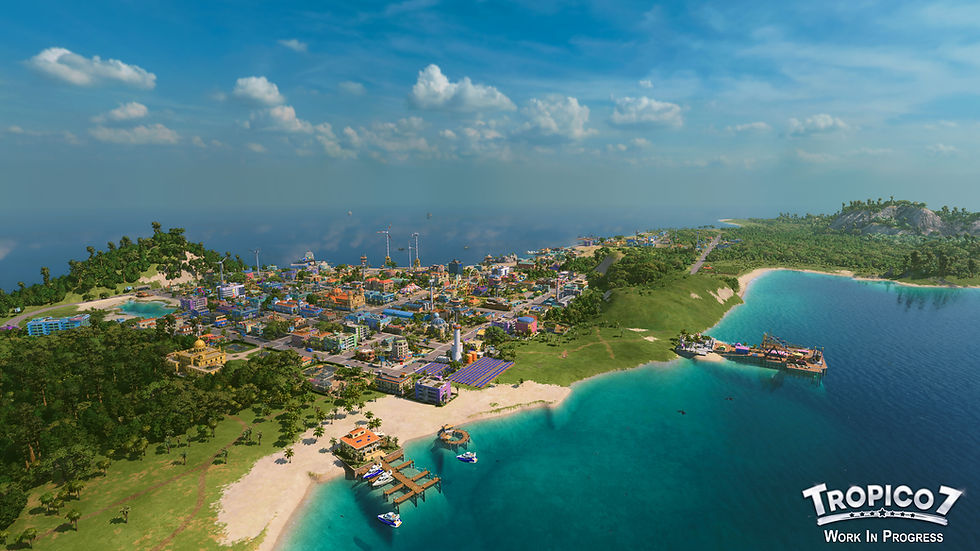
The simulation of each citizen has always been a big part of the Tropico series. Where are your citizens right now? What are they doing? Why are they doing it? And how happy are they about it? (Stalking mode: engaged)
The supermarket, for example is an important location for all citizens because without food, they die – and therefore won’t be able to vote for you! However, it is not enough for a citizen to simply have a supermarket nearby. The player should build the city in such a way that the citizen can actually reach it, enter it (without having to wait in line for hours first), and find the goods they need.
From a game design perspective, this poses an advantage: you are rewarded for building attractive and functional cities, just like those that exist in the real world, which make their citizens happy. As all citizens are simulated and can be found anywhere in the world at any time, regardless of where they happen to be, you can select a citizen and view their satisfaction levels. This allows you to see how a Tropican lives and what opinions they have.
The great thing about a simulation game is that everything can be analyzed in some way, and one thing always leads to another!
Let’s take satisfaction levels as an example: The better a citizen’s needs are met and the more easily they can manage their responsibilities, daily routines, and needs, the more satisfied they are. This satisfaction naturally translates into support for our beloved El Presidente in the next election (VERY important).
2) The satisfaction levels – because a happy citizen is a happy voter
Regarding satisfaction levels, it was important for us to provide you with feedback on all aspects you can control. If a Tropican has a doctor near their home, that makes them happier. If the trash isn’t picked up in front of their home, that makes them less happy, and so on. The satisfaction levels are therefore meant to reflect how well a citizen – who is living in the city – experience your Tropico.
Here is an overview of the satisfaction metrics and how they are determined for each individual citizen 👇
Base satisfaction and dynamic satisfaction metrics:
Each citizen has 10 satisfaction scores and some of these consist of static and dynamic values. Such as when accessible buildings are counted towards satisfaction score.
A citizen can only visit a building if they live within its radius of influence. It is therefore impossible for a citizen to visit a chapel on the other side of the island, for example. If a citizen lives within the vicinity of three chapels, only one chapel will be counted for the base satisfaction.
Dynamic satisfaction is determined whenever a citizen visits one of these buildings. For example, if a citizen lives within the influence radius of a supermarket, this increases their base satisfaction for food and consumer goods. If the citizen then visits this supermarket to meet their needs, the visit determines their dynamic satisfaction (e.g. how successful was the visit, taking into account the service quality and food variety of the building).

Key satisfactions:
For every citizen, food, health, and work are the most important factors. The lower any of these three values is, the more it negatively impacts the citizen’s approval rating.
Food
Base satisfaction: determined by different shops within a citizen’s vicinity
Dynamic satisfaction: determined by how successful the visit to one of these stores was.
Health
Same as food (only healthcare buildings count here)
Work
Satisfaction: determined by quality of job
Consumption
Satisfaction: determined by different shops within a citizen’s vicinity
Entertainment
Base satisfaction: determined by the variety of buildings within a citizen’s vicinity
Dynamic satisfaction: determined by the service quality of the visited building
Housing
Satisfaction: determined by the housing quality, the beauty & pollution of the neighborhood (spoiler alert: shacks have very low housing quality)
Liberty
Satisfaction: determined by the feeling of liberty surrounding a citizen’s residence & workplace (e.g. military buildings reduce liberty in their vicinity but soldiers receive a bonus to liberty)
Safety
Satisfaction: determined by the safety surrounding a citizen’s residence & workplace
Mobility
Satisfaction: determined by how well a citizen can commute to and from work as well as travel through the (incredibly beautiful) city (e.g. low ratings indicate that the citizen has to walk a lot or gets stuck in traffic – but surely, El Prez would never let this happen!)
3) A day in the life of a Tropican
Actually, the term “daily routine” isn't quite accurate: Since several months pass per simulation cycle in the game, Tropicans don't follow fixed daily routines but instead regularly fulfill their most important needs. These include work (~1/3 of the time), time at home with family, and – depending on their current needs – visits to doctors, supermarkets, places of religion, and entertainment venues.
The route a citizen takes varies from case to case and depends on the buildings’ radius of influence that we mentioned before. The larger and more elaborate a building is, the larger its radius.
The length of a route depends heavily on the distances between stops. Citizens use all available modes of transportation for this – from walking to cars, buses, and subways. A well-planned infrastructure thus becomes a key factor in your success.
The dedicated Tropico 7 team has implemented several key measures to make citizens’ routes more efficient and the cityscape as varied as possible:
Buildings have a radius of influence for food, consumption, faith, health, and entertainment. Citizens who live within the radius of influence of a building that meets a specific need receive a base level of satisfaction. The more different buildings of a given type there are, the higher this base satisfaction level becomes.
Citizens visit buildings if they live in their influence radius. This prevents citizens from traveling too far and wasting too much time on the journey.
Which building a citizen visits is random (e.g. there are a ton of available entertainment buildings). This ensures that all buildings are utilized and that one building isn’t constantly overcrowded while another is completely empty.
Let’s do some important, and totally authorized surveillance:

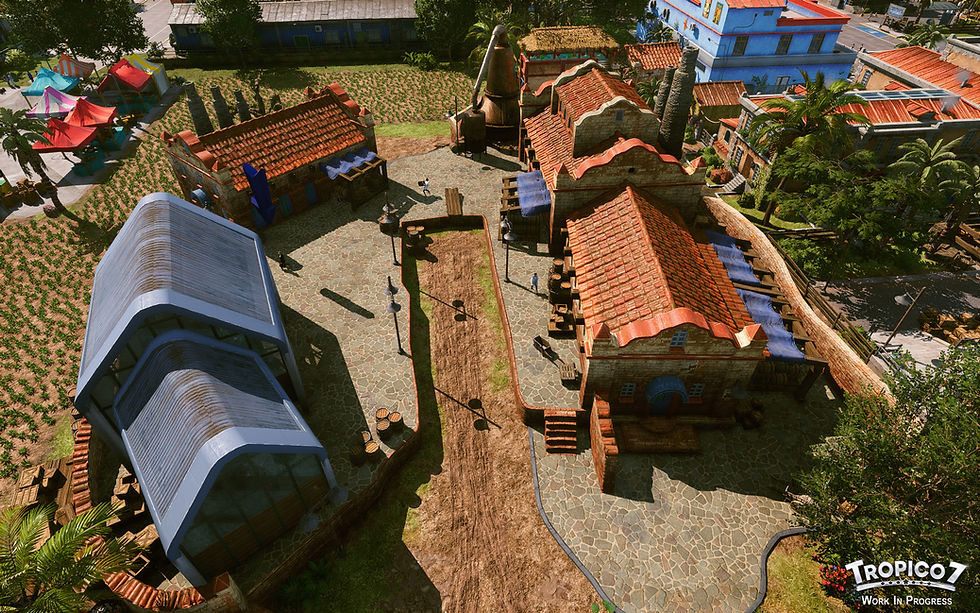
This is Heidrun Martínez. She is a citizen of Tropico. She is married, has 2 kids, lives in the tower block and works at the distillery. (How do we know all of this? State secret 😊)
Let’s stalk cough take a look at the path she’s taking:
A) As her first stop, she’s visiting the church near her residence.

HOME) Afterwards, she’s walking home (while thinking about El Presidente, hopefully).
B) Time to shop! First, she is walking to subway station 1, riding to subway station 2 located at the supermarket.
C) Time to work (and boost the Tropican economy)! Luckily, the distillery is located right next to the supermarket. There, she’s staying for a long time, producing drinks (such a hard-working citizen).
HOME) Done – time to head back home (and recover from the work stress…). Walking home is a great way to cool off!
D) Whoops, the stress was too much (or maybe she sipped on too much rum…) – time to go to the doctor!

E) Afterwards, she’s going to her workplace and back home again.
F) Time for entertainment! She’s visiting the cinema (today’s recommendation, and only movie: The success story of El Presidente)

And like this, the routes just keep going on and on. It’s impossible to predict exactly when she’ll satisfy which need, or which buildings she’ll visit – with the exception of her home and workplace.
Let’s take a look at her satisfaction levels:

Heidrun is quite satisfied, and her approval rating is good. She will definitely vote for El Prez in the next election! (Or else…?!)
What stands out is her satisfaction with faith. The tooltip says:

It seems she had trouble getting to church last time. She was there, but apparently couldn't find a seat. That fits with what she was thinking:

This can happen when too many citizens try to visit a building at the same time. We intentionally programmed the game so that citizens choose buildings at random, rather than selecting the nearest one or the one with the shortest line, to not make it too easy for you 😉.
In this case, this means not enough religious buildings were built near her residential area in the center. The tooltip indicates that base satisfaction is good, but when citizens try to visit the buildings, they (sometimes) give up because the line is too long.
When selecting the church, the numerous blue arrows indicate that the building is very crowded. In the menu on the right side, you can also see that all visitor spots are occupied. Everyone who finds the line too long leaves and thus reduces their dynamic satisfaction. It would be best to build another church (a cathedral can’t be built yet, since this requires a really good relationship with the religious faction). Neither of these buildings will increase base satisfaction, because only the first building of a given type increases base satisfaction. However, additional buildings do increase the number of visitor slots.

We hope this journey raised your satisfaction levels and quenched your thirst for knowledge about Tropico 7 (even if just a little). Take your notes and when the time comes to take the lead in-game, you’ll be able to rule like no other before! (Please don’t apply this in real-life – stalking is only allowed in Tropico!)
While the dev team continues to work hard on the game, let us know what you thought of this dev-log on Discord, Steam or any of our social channels!
Stay tuned for more, Tropicans! And don’t forget to add Tropico 7 to your wishlist and show El Presidente your much appreciated loyalty!